Pricing and Monetization
Where Discounting Quietly Leaks Revenue in Sales-Led Deals
In sales-led businesses the discount a customer receives often depends on who sold the deal rather than what the deal is worth. Give-to-get rules and a deal desk close that gap.
Jana Schuster · December 9, 2025 · 4 min read
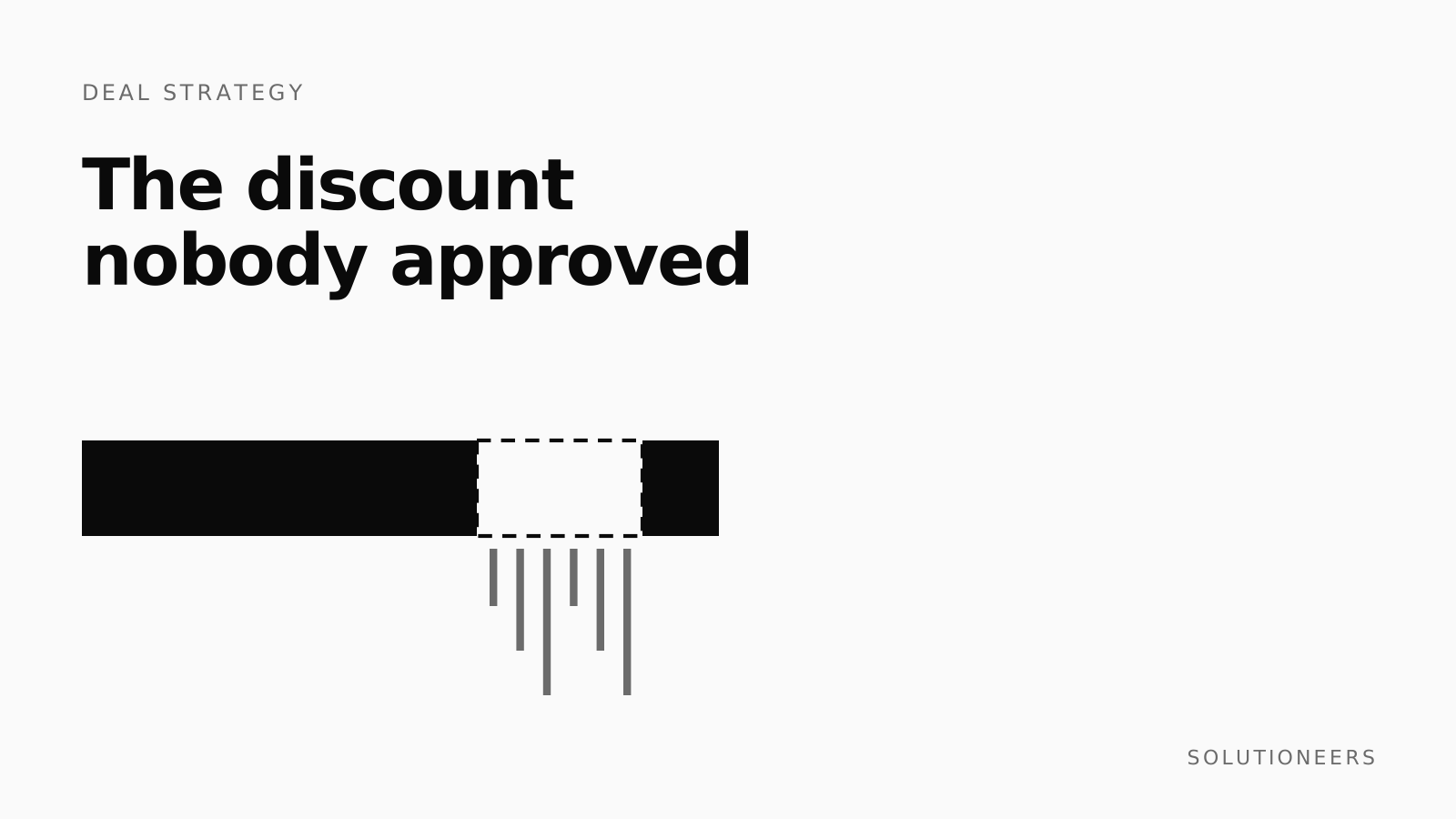
In a sales-led business, the price a customer pays is set twice. Once by the company, when it publishes a price list, and once by whoever runs the deal. The second number is the one that shows up in revenue.
The gap between those two numbers is usually treated as a cost of doing business. It is more useful to treat it as a measurable thing with causes, because once you look at past deals the variation turns out to follow patterns that have little to do with what the deal is worth.
The discount often reflects the seller, not the deal
An enterprise security software provider the Solutioneers team worked with had this problem in a form that is easy to recognise. Discounts varied widely across the business, and nobody could explain the variation, because no one had looked at it as a dataset.
The work started by analysing past deals across five dimensions: rep, customer type, region, use case and deal size. Deal size is the dimension everyone expects to drive discounting, and it did, partly. The others mattered more than the company expected. Similar customers buying similar things were paying materially different prices depending on who sold to them and where.
That is the leak. Not fraud, not incompetence. Individual reps making locally reasonable decisions without a shared rule for what a concession is worth.
Discounts given without asking for anything back
The second pattern is structural. In most sales-led companies, discounts are granted in exchange for nothing.
A customer asks for a lower price. The rep, under quota pressure near the end of a quarter, agrees. The customer gives up nothing: not a longer term, not an annual prepayment, not a case study, not a reference call, not a wider initial deployment. The concession flows one way.
This is the problem give-to-get rules solve. A discount stays available, but it is attached to something the company wants. Longer commitment, payment terms, multi-year pricing locks, expansion commitments. The rep keeps a tool for closing deals and the company stops giving away margin for free.
In text: 1. Analyse past deals by rep, customer type, region, use case and size 2. Write give-to-get rules so every discount buys something 3. Train the sales team on the rules 4. Route exceptions through a deal desk
A deal desk handles the cases the rules do not
Rules cover the common cases. They will not cover the deal that is strategically important, structurally unusual, or large enough to deserve its own analysis.
A deal desk gives those deals somewhere to go other than an escalation to whoever is most senior and least informed. It also creates a record. Over a few quarters the desk accumulates a history of which exceptions were granted and what happened afterwards, which is the input to the next revision of the rules.
Without that route, exceptions do not disappear. They get made informally, under time pressure, by whoever answers the phone.
What changed for the security provider
After the deal analysis, the give-to-get rules, the training and the deal desk, the average discount rate fell by seven percentage points and deal cycles shortened.
The second result is the one that surprises people. The expectation is that adding governance to discounting slows deals down, because more approvals mean more waiting. What happened instead is that reps stopped negotiating from scratch on every deal. A clear rule about what a discount costs and what it buys removes a round of internal argument before the customer conversation even starts.
In text: 7 points reduction in average discount rate. Shorter deal cycles after the rules and deal desk were introduced.
Start with the analysis, not the policy
The common mistake is to begin with a discount policy. A policy written before the analysis encodes the assumptions you already had, and it will be ignored by the people who know their deals better than the policy does.
Begin instead with the five-way cut of past deals. It takes billing data joined to CRM data, and it produces a picture specific enough that the sales leadership cannot dismiss it. The rules you write afterwards will be about the variation you actually have rather than the variation you imagined.
One caution. This analysis tends to make individual reps look bad. It is worth framing from the start as a question about missing rules rather than individual judgement, because the reps who discount most steeply are usually the ones working the hardest deals.
If discounting is where your pricing leaks, our pricing and packaging work begins with the deal analysis described here.
Related reading: The Four Data Sources Every Pricing Decision Needs and Setting Renewal Price Increases Based on Actual Usage.
Share this post