Pricing and Monetization
How to Set AI Credit Rates and Allowances Customers Can Predict
Credits are the most common way software companies are now charging for AI. The launches that went badly share one trait: customers could not predict what they would spend.
Jana Schuster · August 18, 2026 · 5 min read
Credits have become the default way software companies charge for AI. In the State of B2B Monetization in 2026, Kyle Poyar found that 29% of companies use AI credits and 33% plan to introduce them in the next 6 to 12 months, with roughly half of companies above $50M ARR already using them.
The appeal is obvious. Credits let revenue move with cost without exposing customers to a raw per-call meter. The difficulty is that a credit is an invented unit, and customers cannot budget for a unit they do not understand.
Several companies have now launched credit models publicly, and the ones that went badly share a single trait.
Pooling makes the allowance legible
In June 2026, Gong introduced 2,000 AI credits per paid core seat per year, pooled across the company, as documented by Supered.
Two decisions are doing the work there. The allowance is tied to something the customer already understands, which is the seat count they are already buying. And the credits are pooled, so a heavy user does not run out while a light user leaves credits unspent.
Pooling is the detail that makes an allowance usable. Per-user allowances produce a situation where the company has credits left over in aggregate and individual people are blocked, which generates support tickets and resentment at the same time.
Atlassian took a similar shape in June 2026, including 25 Rovo AI credits per user per month in standard plans, with some agents billed per conversation beyond the included limits.
Rates should reflect cost, visibly
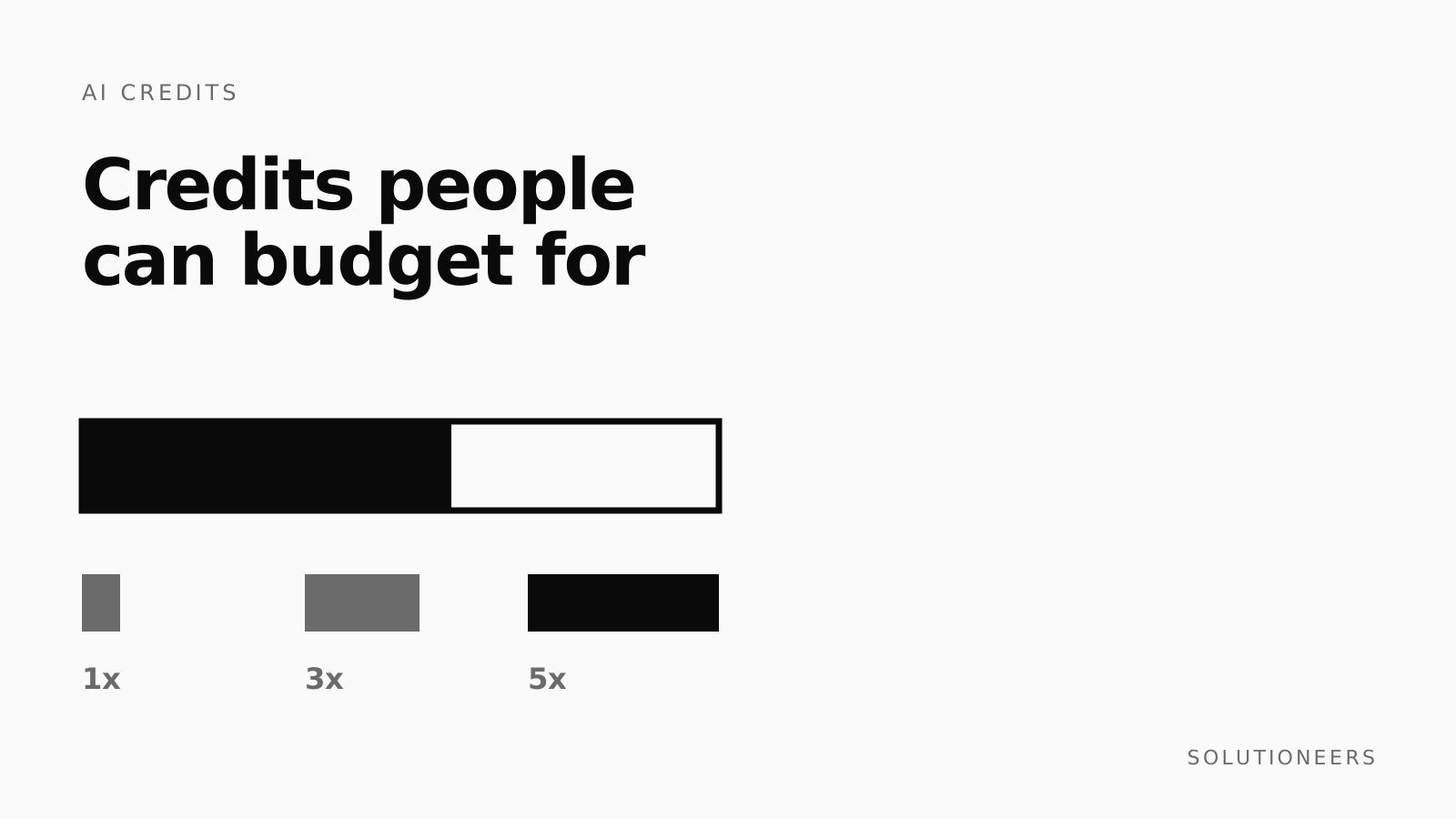
On 15 June 2026, Zapier began pricing AI steps by model tier: Standard at 1x, Advanced at 3x as the default, and Premium at 5x.
This is the clearest public example of passing model cost through to the customer in a way they can act on. A customer who does not need the most capable model can choose a cheaper one and get more work from the same allowance.
The multipliers are small integers, which matters. A customer can hold 1x, 3x and 5x in their head and reason about a tradeoff. A rate card with two decimal places cannot be reasoned about at all, and will be ignored until the bill arrives.
The default is also a decision. Zapier set Advanced at 3x as the default, which means most usage draws at three times the base rate unless a customer actively changes it.
In text: Premium: 5x. Advanced (the default): 3x. Standard: 1x.
Taking away unlimited use is the hard move
Notion's path, documented by Pricing Innovation, ran from a flat AI add-on in 2023, to inclusion in the Business tier in 2025, to workspace credits in August 2026. Users reacted to losing unlimited use.
That reaction is the predictable cost of the sequence. Customers who have had unmetered access build habits and workflows on the assumption it will continue. Introducing a meter later is experienced as a reduction even when the allowance is generous enough that most customers never hit it.
The lesson is about ordering. A capability launched with an allowance from day one is just how the product works. The same allowance introduced two years later is a takeaway.
In text: 1. Flat AI add-on, 2023 2. Included in the Business tier, 2025 3. Workspace credits, August 2026 4. Users reacted to losing unlimited use
What makes credits predictable
Four properties, drawn from what the public launches did well.
Tie the allowance to something already bought. Per seat, per workspace, per contracted tier. A number the customer already knows gives the allowance a reference point.
Pool it. Allowances that cannot be shared waste capacity and block individuals at the same time.
Keep the rate card short and in whole numbers. A customer should be able to estimate their monthly consumption on the back of an envelope.
Show consumption in the product, before the invoice. A customer who can see they are 60% through the month's allowance on day twelve can change behaviour. One who finds out from a bill cannot.
Decide what happens at the limit
The most important design question is what happens when a customer runs out. Hard stop, automatic overage, or a prompt to buy more.
A hard stop is predictable and will break a workflow at the worst moment. Automatic overage keeps things working and produces the surprise invoice that destroys trust. A prompt sits in between and requires someone to be paying attention.
There is no universally right answer, but there is a wrong one, which is leaving it undecided until a customer hits the limit for the first time.
If you are designing a credit model, our pricing and packaging work covers rates, allowances and the rollout.
Related reading: Forecasting Revenue After Moving Part of Pricing to Usage or Credits and How to Price AI Features Without Pulling Customers Down From Your Higher Tiers.
Share this post