Pricing and Monetization
Companies Create More Value Than Ever but Capture Less of It
AI has made it faster to build and ship than to decide what any of it is worth. Software is shifting from selling access to selling work, and pricing has not kept pace.
Jana Schuster · September 29, 2026 · 6 min read
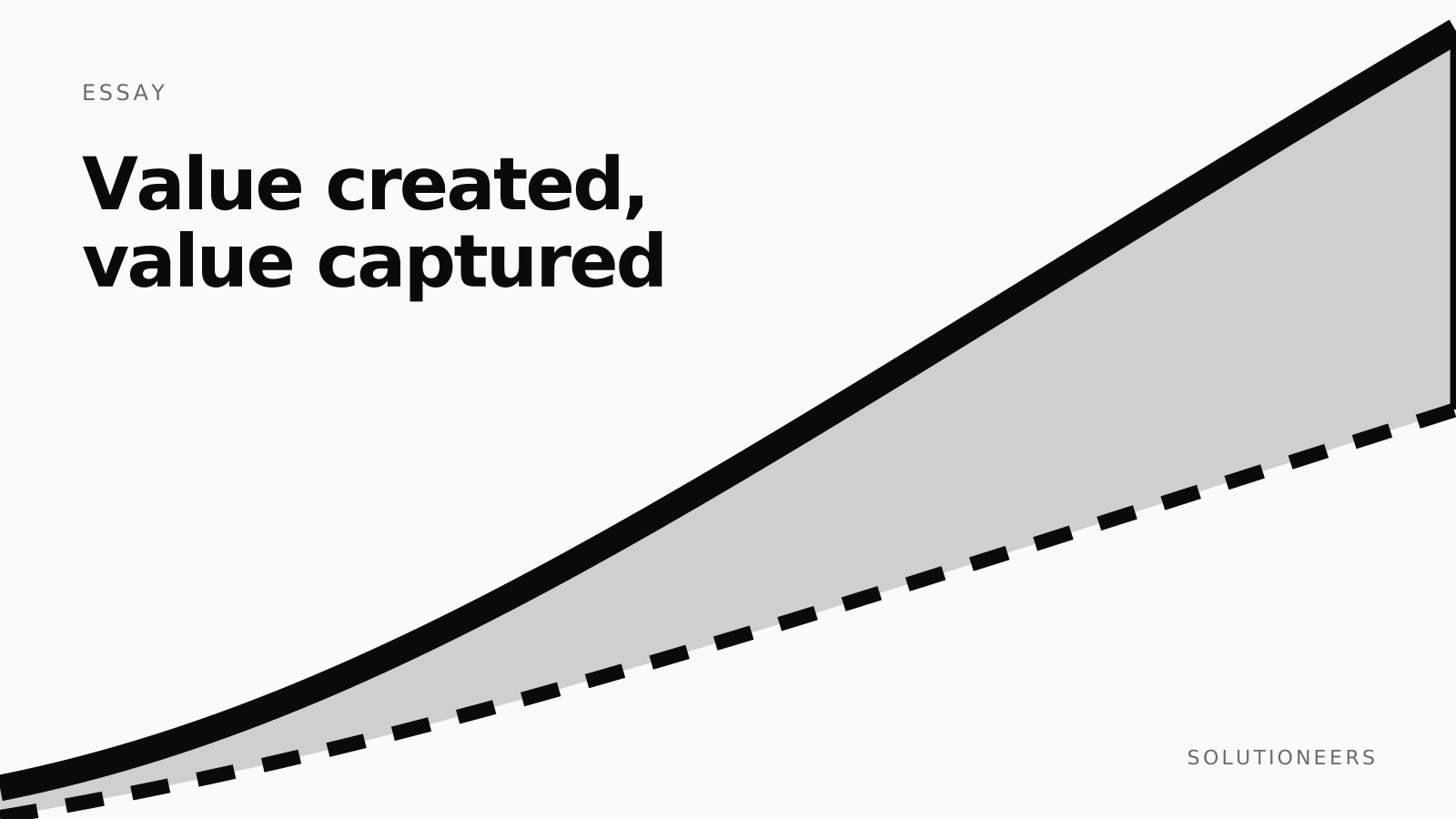
Software companies have never been able to build this quickly. Capabilities that would have taken a year to ship now take a quarter, and the gap between an idea and a working feature keeps shrinking.
The mechanism for deciding what any of it is worth has not changed at the same rate. Most companies still open pricing once a year, settle it, and close it again. The result is a widening distance between the value a company creates and the share of it the company captures.
The gap is structural, not a failure of effort
This is not happening because pricing teams are slow. It is happening because the two activities run on different clocks.
In the 2025 State of B2B Monetization, Kyle Poyar found that three in four companies changed pricing or packaging in the past year, and that most were unprepared to keep up because of personnel gaps and legacy tooling. He also found that between $5M and $20M ARR, pricing ownership often falls between teams.
Companies are already changing pricing more than once a year. They are doing it without the ownership, process or systems to do it well, which means each change costs more and resolves less than it should.
Software is moving from selling access to selling work
The deeper shift is in what is being sold.
For thirty years, software sold access. You bought the right to use a tool, usually per person, and what you did with it was your business. The vendor's cost did not vary much with your intensity, so the price did not either.
AI products sell work. The software does something that a person would otherwise have done. The vendor's cost now moves directly with how much work is requested, and the value to the customer is measured in work completed rather than in access granted.
Two 2026 data points show the market repricing around this.
Gartner forecasts 2026 worldwide spending of $1.44 trillion on software and $1.87 trillion on IT services. Services, which is where companies buy work rather than tools, is the larger number. As software starts doing work rather than enabling it, it is addressing the bigger of those two budgets.
And on 2 December 2025, Stripe announced an agreement to acquire Metronome at a reported $1 billion, without disclosing terms. Patrick Collison said: "Metered pricing is the native business model for the AI era." The infrastructure for charging by consumption drew that price because the thing being measured has become the thing being sold.
In text: IT services: $1.87 trillion. Software: $1.44 trillion.
The economics changed underneath the pricing
The old model assumed near-zero marginal cost. Almost everything about how software companies are run follows from that assumption.
It no longer holds. In the State of B2B Monetization in 2026, Poyar's survey of more than 230 software companies found that the median target gross margin for AI products is about 50%, and only 12% aim for 80% or higher. ICONIQ's January 2026 State of AI snapshot, as reported by SaaStr, found AI product gross margins projected to rise to 52% in 2026 from 41% in 2024, and that 37% of companies plan to change their AI pricing within 12 months.
A business running at half its historical gross margin cannot treat pricing as an annual administrative exercise. At 80% margin, a pricing mistake is absorbed. At 50%, it is the difference between a healthy product and one that grows revenue while losing money.
The models are already moving
The same research shows the shift underway. 37% of companies now run hybrid pricing, up from 25%. 29% let customers choose between pricing models, up from 21%. 29% use AI credits and 33% plan to introduce them within 6 to 12 months, about half of companies above $50M ARR.
Investor preference has moved with it. Only 10% of respondents think investors favour flat-fee pricing, and 5% seat-based.
In text: 37% run hybrid pricing, up from 25%. 29% let customers choose a pricing model, up from 21%. 10% think investors favour flat-fee pricing.
Capturing value requires a different cadence
If the product changes monthly and the cost of serving each customer varies with use, the pricing process has to run continuously rather than annually.
Continuous does not mean changing prices constantly. Customers need stability, and a company that reprices every quarter will lose trust faster than it gains revenue. It means the inputs are always current, so that when a decision is needed it can be made in days from live data rather than in six weeks from a reconstruction.
That requires three things most companies do not have. Someone who owns the pricing recommendation. A standing view that joins billing, CRM, usage and cost data. And a default rule for what happens when a feature ships without a pricing decision, because the current default at most companies is that it joins the cheapest plan the customer already has.
The gap compounds
Every release that ships without a monetization decision is small on its own. Over two years of monthly releases it becomes the reason your average revenue per customer has not moved while your product has improved substantially.
The companies that close this gap will not be the ones with the cleverest pricing model. They will be the ones that made pricing an ongoing function with current data behind it, so that the decision about what something is worth happens near the moment the thing is built.
If the distance between what you create and what you capture is widening, our pricing and packaging work is where we start.
Related reading: Revenue and Margin Are the Same Problem and Why an Annual Pricing Review Is Too Slow When You Ship Every Month.
Share this post