Pricing and Monetization
Seat Pricing When AI Means Customers Need Fewer Seats
When your product makes each user more efficient, seat pricing turns your best work into a smaller invoice. The alternative is to charge for the work the product does.
Jana Schuster · March 17, 2026 · 4 min read
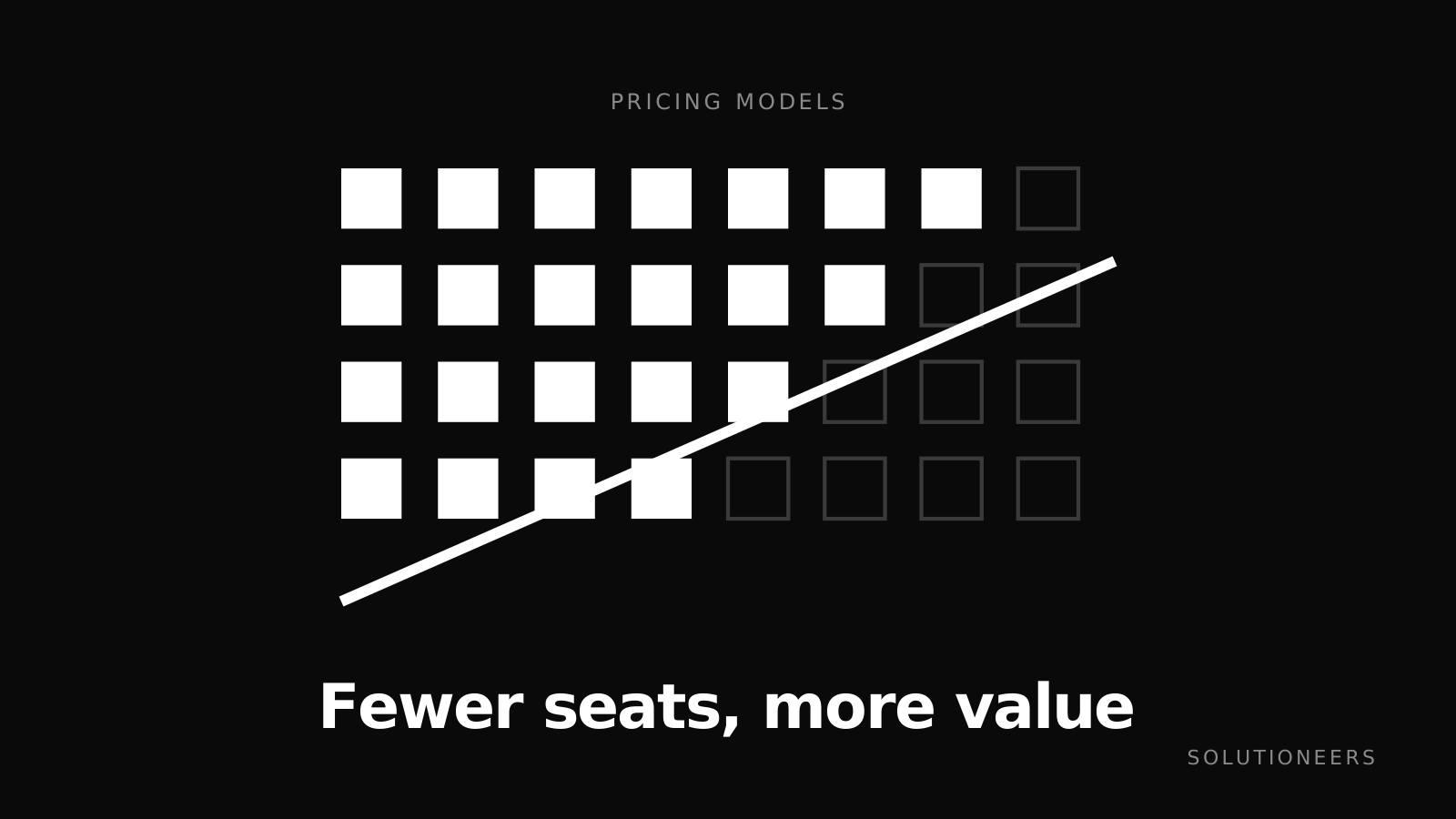
There is a specific trap waiting for software companies that charge per seat and are building AI into their product. The better the AI works, the fewer seats the customer needs.
A practitioner commenting on Clouded Judgement described it plainly: every feature they built to make support agents more efficient reduced their customers' demand for seats. The product worked. The invoice shrank.
This is not a hypothetical risk for support software, sales tooling, service desks or any product where a seat corresponds to a person doing repetitive work. It is the direct consequence of succeeding.
The misalignment is in the metric
Seat pricing works when the number of people using the product tracks the value the customer gets. For most of software's history that held. More users meant more work being done in the product, which meant more value.
AI breaks the link. The work still gets done. It is just done by fewer people, or by the software itself. Value delivered goes up while the billing metric goes down.
The uncomfortable version of this is that under seat pricing, your best engineering work is a discount you give your customer automatically and without negotiation.
In text: 1. Product automates part of a user task 2. Each remaining user handles more volume 3. Customer needs fewer seats to do the same work 4. Billing falls while work delivered stays flat
Four directions, none of them free
There is no option that keeps the simplicity of seat pricing and removes the misalignment. There are four directions, each with a cost.
Charge for the work, not the worker. Price on the unit of output the customer cares about: tickets handled, documents processed, conversations resolved. This realigns price with value and is the most direct answer. It also means your revenue becomes variable and harder to forecast, and it requires you to define the unit precisely enough to bill for it, which is harder than it sounds.
Raise the price per seat. If each seat now does three times the work, a seat is worth more. This is the smallest change operationally and the hardest conversation commercially, because customers experience it as a price rise even when the value per seat has genuinely increased. It works best at renewal, supported by usage data showing what each seat now handles.
Keep seats and add a second meter. Seats for access, consumption for the AI capability. This preserves the predictable base and captures the variable value. It is the most common direction right now, and the main risk is that two meters are harder for a customer to budget than one.
Price a platform fee against capacity. Charge for a level of throughput rather than a number of people. This fits customers who are explicitly buying automation and do not think in terms of headcount at all.
Decide before the efficiency arrives
The timing matters more than the choice. Each of these is far easier to implement before customers have experienced the seat reduction than after.
Once a customer has cut their seat count in half and seen their bill fall, any change you introduce reads as clawing back a saving they have already banked. Before that point, the same change is a straightforward conversation about how a new capability is priced.
That argues for deciding the model when you are building the AI capability rather than when the renewal data shows the decline.
What to look at first
Two numbers will tell you how exposed you are.
First, the trend in seats per account among customers who have adopted your AI features, compared with customers who have not. If adopters are shrinking faster, the effect is already present in your base.
Second, the work volume per seat over the same period. If each seat is handling meaningfully more and paying the same, you have quantified exactly what the current model is giving away.
Both come from product usage data joined to billing data. Neither requires a new pricing model to produce, and together they turn an abstract concern into a number you can take to a pricing decision.
The simplicity is worth something
None of this means seat pricing is finished. It remains the easiest model for a customer to understand, budget and approve, and that is not a small advantage.
The point is narrower. If your product is becoming materially more efficient for the people using it, the seat count will stop being a reasonable proxy for value, and continuing to bill on it is a decision rather than a default.
If your AI roadmap is working against your pricing model, our pricing and packaging work addresses that directly.
Related reading: Expansion Revenue Under Seat Pricing and Define the Outcome Before You Price on Outcomes.
Share this post