Pricing and Monetization
Moving Existing Customers to New Pricing Without Losing Them
A price change lands differently on each segment of your base. Modelling who pays more and who pays less before launch is what protects revenue and retention.
Jana Schuster · January 13, 2026 · 4 min read
The hard part of a pricing change is rarely the new price. It is the several thousand customers already paying the old one.
A new model that works beautifully for new business can still cost you more than it earns if the migration is handled as an announcement rather than a plan. The customers who will pay more under the new structure are the ones most likely to leave, and they are often the customers you least want to lose.
Model the base before you design the model
The step that gets skipped is the one that determines everything else. Before you finalise a new structure, run every existing customer through it and see what they would pay.
You are looking for three groups. Customers who pay roughly the same, who are the easy majority. Customers who pay less, who are a revenue question. Customers who pay more, who are a retention question.
The size and shape of those three groups should influence the design of the model itself. If the third group contains your twenty largest accounts, the model is wrong, or the migration needs to be slow and negotiated rather than announced.
This requires billing data joined to usage data. It cannot be done from the price list alone, because the price list does not know what each customer actually has or what they actually use.
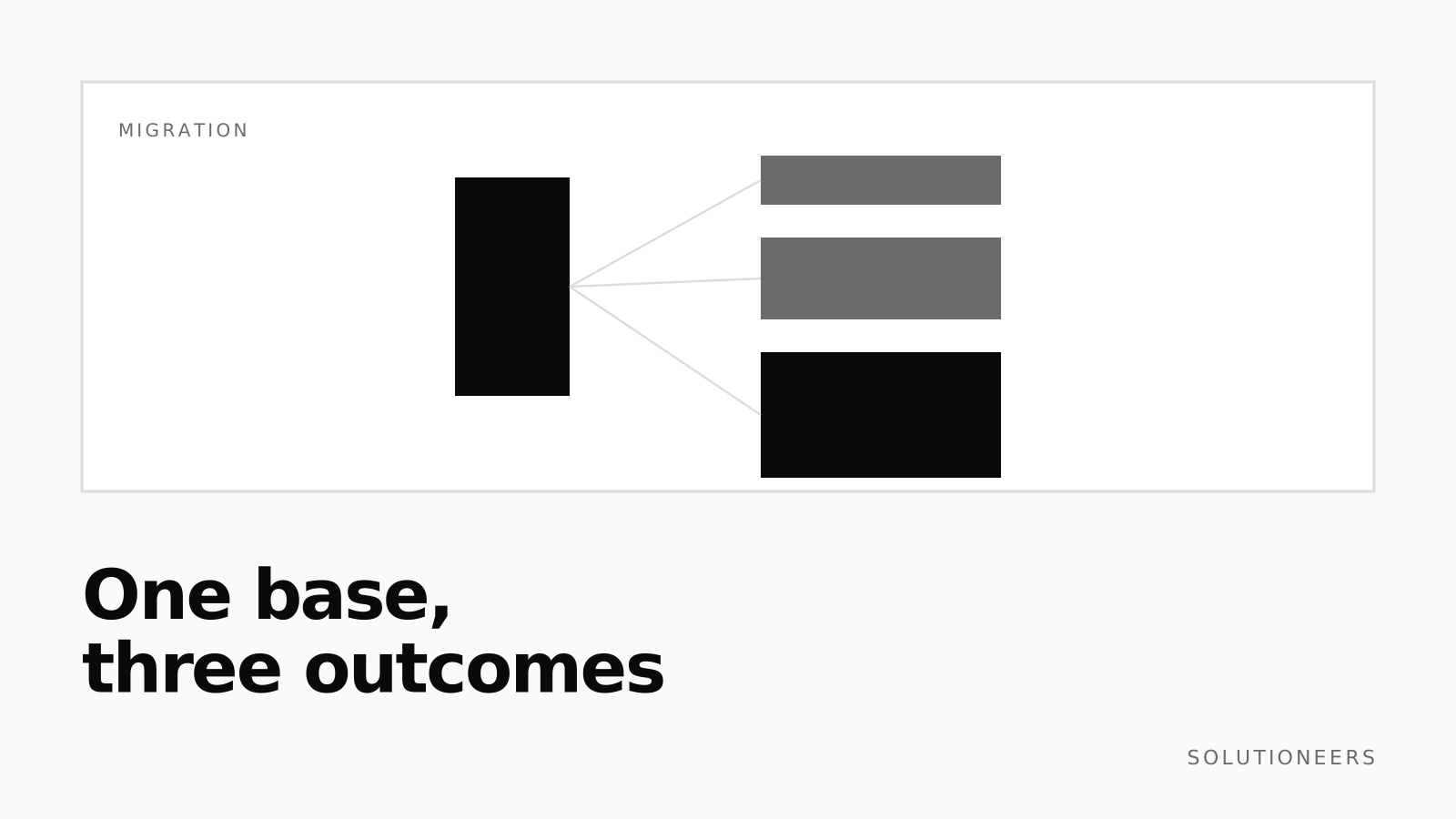
In text: 1. Run the current base through the proposed model 2. Split into pays less, pays the same, pays more 3. Design terms for each group before announcing 4. Migrate in waves and watch retention
Segmentation is not just company size
A large payment processor the Solutioneers team worked with charged a mix of subscription and transaction fees. The pricing treated customers as one population, and the result was a structure that fitted almost none of them well.
The work segmented customers by behaviour, size and price sensitivity rather than by size alone. Behaviour matters because two customers of identical size can use the product in ways that cost very different amounts to serve. Price sensitivity matters because it determines which customers respond to a change by negotiating, by shrinking, or by leaving.
What came out of that segmentation was not a single new price. It was three different structures: lower fixed fees for small customers, usage-scaled pricing for large ones, and a hybrid for customers in between who were growing.
Lower prices for some customers can raise total revenue
The payment processor lowered prices for part of the base. Churn fell by 35% and total revenue grew.
That result is worth sitting with, because it contradicts the instinct that drives most pricing changes. The company was not undercharging across the board. It was charging small customers in a way that made them leave and charging large customers in a way that did not scale with the value they were getting. Fixing both ends moved the total up even though some individual prices moved down.
In text: 35% reduction in customer churn after segmented pricing. Growth in total revenue even though some prices were lowered.
Give each group terms that match its position
Once you know who pays more, the migration becomes a set of smaller decisions rather than one announcement.
Customers who pay less can be moved immediately. There is no retention risk and the goodwill is real.
Customers who pay roughly the same can be moved on their renewal date, which spreads the operational work across the year and avoids a single mass communication.
Customers who pay more need something: a transition period at the old price, a phased increase, a cap on the first year's change, or a conversation that trades the increase for a longer commitment. Which of these you choose depends on how much more they would pay and how much you want to keep them.
Decide what the systems have to do early
A migration plan that works on paper can still fail because the billing system cannot represent it. Grandfathered rates, phased increases, caps and mixed structures all have to exist as real configurations, not as spreadsheet promises that someone honours manually.
The same applies to quoting. If sales cannot generate an accurate quote under the new model on the day it launches, they will keep selling the old one.
The decision that actually matters
Most of the risk in a pricing migration is concentrated in a small number of accounts. Find them first, decide deliberately what you are willing to do to keep them, and let that decision shape the rollout.
A migration that protects the top of the base and moves everyone else on renewal is slower than a single cutover. It is also the version that does not show up as a churn spike two quarters later.
If you are planning a change to pricing your existing customers will feel, our pricing and packaging work covers the modelling and the rollout.
Related reading: Expansion Revenue Under Seat Pricing and Setting Renewal Price Increases Based on Actual Usage.
Share this post