Pricing and Monetization
Why AI Gross Margins Sit Near 50%, and How Pricing and Spend Each Move the Number
Software companies used to expect gross margins well above 80%. AI products are landing near half that, and both pricing and spend decisions move the result.
Jana Schuster · July 14, 2026 · 5 min read
Software has been valued for decades on a simple property: once the product is built, serving one more customer costs almost nothing. Gross margins above 80% followed from that, and nearly every assumption about how software companies are run, funded and valued was built on top of it.
AI products do not have that property. Inference costs money every time the product does something, and that cost scales with use rather than sitting flat.
What companies are actually targeting
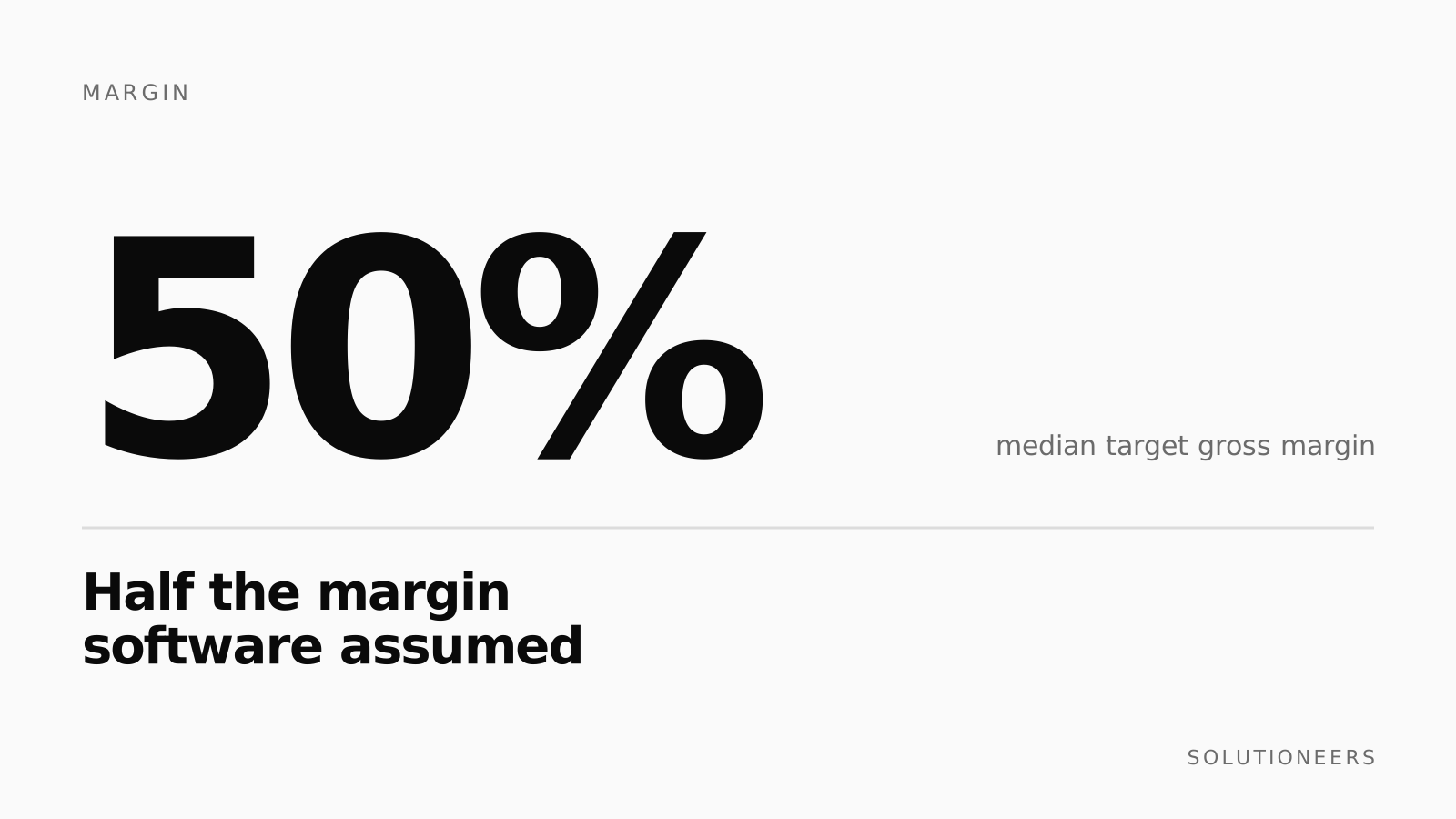
In the State of B2B Monetization in 2026, Kyle Poyar of Growth Unhinged surveyed more than 230 software companies and found that the median target gross margin for AI products is about 50%, and only 12% aim for 80% or higher.
The word to notice is target. This is not a report of companies missing their margin goals. It is a report of companies setting goals at half the level software has historically assumed.
ICONIQ's January 2026 State of AI snapshot, as reported by SaaStr, points the same way, with AI product gross margins projected to rise to 52% in 2026 from 41% in 2024. The direction is improving. The level is nowhere near classic software economics.
In text: Median target, 2026 (230+ companies): about 50%. Projected actual, 2026 (about 300 executives): 52%. Actual, 2024 (about 300 executives): 41%. Companies targeting 80% or higher: 12%.
Cost has become a pricing input
The clearest sign of the shift is what companies say drives their AI pricing decisions. In the Growth Unhinged research, 54% name internal costs and margins as the most important factor, while 36% name competitor pricing.
For most of software's history, cost to serve was not a meaningful input to pricing. You priced on value and competition, because the cost side was a rounding error. A majority of companies now putting cost first is a structural change in how pricing decisions get made, not a temporary reaction to expensive models.
The pricing levers
Three pricing decisions move the margin line directly.
Where the capability sits. An AI feature included in a flat-price plan converts a variable cost into a fixed revenue line. The heaviest users determine your margin and you have no mechanism to charge them more.
Whether there is a limit. Any included AI capability needs an allowance or a rate limit. Without one you are exposed to your most intensive customers, and those customers are usually your largest.
Whether price tracks consumption. Usage, credit and hybrid structures move revenue with cost. The Growth Unhinged research shows this happening: 37% of companies now run hybrid pricing, up from 25%, and 29% use AI credits with another 33% planning to introduce them in the next 6 to 12 months.
The spend levers
The other half of the margin equation is what you spend to deliver the product, and it is often owned by a different team with different incentives.
Model selection is the largest lever. Routing straightforward requests to a smaller model and reserving the expensive one for work that needs it changes unit cost substantially without changing what the customer experiences.
Caching and retrieval reduce repeated inference on questions the system has already answered. Prompt and context size directly affect per-call cost. Infrastructure commitments and reserved capacity trade flexibility for rate.
None of these are pricing decisions, and all of them land on the same gross margin number that pricing lands on.
In text: 37% run hybrid pricing, up from 25%. 29% use AI credits today. 33% plan to introduce credits in the next 6 to 12 months.
The two levers need the same view
The reason this is hard organisationally is that pricing sits with product and finance while infrastructure spend sits with engineering. Each team can improve its own number while the combined result stays flat.
A pricing change that increases revenue per customer looks like a win until you learn that the customers it attracted are the expensive ones to serve. An infrastructure optimisation that cuts cost per call looks like a win until you learn it degraded quality for the segment paying the most.
Seeing both requires cost data attached to customers and to features, not just to infrastructure. That join is usually missing, and building it is the prerequisite for managing AI margin rather than observing it.
Where to start
Calculate gross margin for your AI capability at the customer level for a single month. Not blended across the product. Per customer, with inference and infrastructure cost allocated to the accounts generating it.
The distribution is usually wide, and the customers at the wrong end of it are the specific, nameable input to your next pricing decision.
If AI costs are moving your margin, our pricing and packaging work and our margin optimization work address the two halves of it.
Related reading: How to Price AI Features Without Pulling Customers Down From Your Higher Tiers and Revenue and Margin Are the Same Problem.
Share this post